
Navigating Workplace Drug Testing in New Zealand: A Guide for Employers and Employees
Workplace drug testing in Aotearoa New Zealand sits at a unique intersection of two key pieces of legislation: the Health and Safety at Work Act 2015 (HSWA) and the Employment Relations Act 2000 (ERA).
While employers have a statutory duty to ensure a safe work environment, employees have rights to privacy, bodily integrity, and procedural fairness. Balancing these priorities requires clear policies, fair processes, and proportional responses.
1. When Can Employers Drug Test?
In New Zealand, an employer cannot simply demand a drug test out of the blue. For drug testing to be lawful, three main criteria must be met:
Explicit Agreement & Policy
The right to drug test must be explicitly stated in the Employment Agreement or an established, well communicated Workplace Drug and Alcohol Policy. Without a written clause or policy that the employee has consented too, forcing a test can be deemed an unlawful breach of privacy under the Privacy Act 2020.
Justification and Scope
Safety Sensitive Roles: Random drug testing is generally only justifiable in roles where impairment poses a direct, serious risk of harm (e.g., operating heavy machinery, driving commercial vehicles, construction, aviation, or healthcare).
Reasonable Cause / Post Incident: Testing an office worker or non-safety sensitive employee usually requires "reasonable cause" (e.g., visible signs of impairment on duty) or following a significant workplace accident/near-miss.
Consent
Because drug testing involves collecting biological samples, an employee must consent before the test is administered. However, if an employee unreasonably refuses a test where a clear policy exists, that refusal itself can be treated as a breach of contract or potential misconduct.
2. What Happens if an Employee Fails a Drug Test?
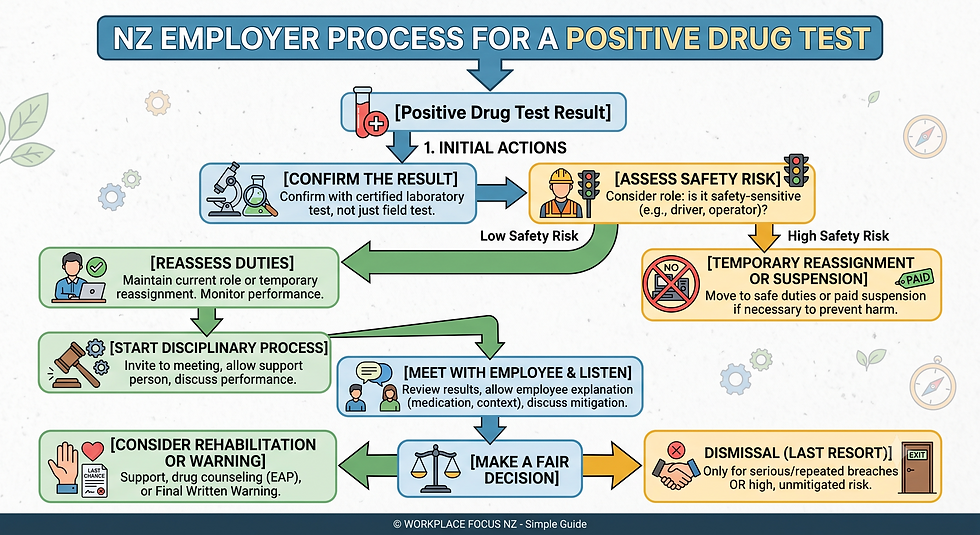
A "non-negative" or positive test result does not equal an automatic dismissal. In New Zealand, standard dismissal rules under the ERA still apply, meaning a fair and reasonable process must be followed.
[Positive/Non-Negative Result]
        │
        ▼
[Initial Meeting & Risk Assessment] ──► Optional Temporary Suspension (With Pay)
        │
        ▼
[Formal Disciplinary Process] ──► Written Allegation & Right to Support/Representation
        │
        ▼
[Employee Response & Mitigating Factors]
        │
        ▼
[Proportional Action / Outcome] ──► Rehabilitation, Warning, OR Dismissal
Steps the Employer Must Take
Provide the Full Results; share the official laboratory report (often requiring a confirmatory lab test, as initial field tests can give false positives).
Consider Temporary Action (Paid Suspension); if keeping the employee on site poses a health and safety risk, the employer may temporarily suspend them on full pay while an investigation takes place. The employee must be given a chance to comment on the proposed suspension first (read my blog on suspensions).
Formal Notification; write to the employee outlining the allegation (breach of policy/serious misconduct) and invite them to a formal disciplinary meeting.
Follow Due Process; allow the employee time to prepare, bring a union representative or support person, and explain their side.
Steps the Employee Can Take
Request Lab Confirmation. If an initial rapid swab/urine test was positive, request that the sample undergo full laboratory gas chromatography-mass spectrometry (GC-MS) verification.
Explain the Context. Disclose any legally prescribed medications (e.g., medicinal cannabis, strong painkillers, ADHD medication) or over the counter drugs that could have triggered the result.
Seek Support & Representation: Involve a union delegate, employment advocate, or lawyer.
Engage via Self-Reporting / EAP: If struggling with substance use, ask if the company offers an Employee Assistance Programme (EAP) or rehabilitative pathways.
3. Employer Responses: It Doesn't Have to Be Dismissal
Dismissal should generally be a last resort unless the breach constitutes gross serious misconduct or poses an immediate, unmanageable safety danger.
An employer's response should depend on role severity, historical performance, and the specific circumstances:
Factor | High-Risk Role (e.g., Crane Operator) | Low-Risk Role (e.g., Graphic Designer) |
Safety Impact | Extremely high hazard to self and others. | Minimal direct physical safety risk. |
Initial Action | Immediate removal from safety-critical duties. | Discussion regarding workplace expectations/performance. |
Potential Alternatives | • Temporary reassignment to desk duties. • Rehabilitation agreement & regular testing. • Final written warning. | • First or final written warning. • EAP counselling support. • Flexible working arrangements during recovery. |
Grounds for Dismissal | High likelihood if the employee refuses rehabilitation or poses an unmitigated safety risk. | Low justification for immediate summary dismissal solely based on presence of substances without impairment. |
Alternatives to Termination: The Rehabilitative Approach
Modern employment law encourages a support first or rehabilitative framework where appropriate:
Rehabilitation / Last-Chance Agreements: The employee agrees to undergo professional counselling or addiction treatment, taking unpaid leave or performing non safety sensitive work. Return to normal duties is conditional on passing future unannounced tests.
Formal Warnings: A first or final written warning placed on the employee's file, establishing clear expectations moving forward.
Redeployment: Moving the worker to a non-hazardous role temporarily or permanently.
Key Takeaways for Workplace Harmony
For Employers: Ensure your drug and alcohol policy is clear, accessible, and consulted on with staff. Never skip procedural fairness—even a positive test result can turn into a costly Personal Grievance (PG) if you dismiss an employee without proper process.
For Employees: Know your employment agreement. If you take prescription medication that causes impairment, proactively communicate with your employer or HR. If facing a test or disciplinary action, always exercise your right to bring a support person.


Comments